

The Westsider™ · Vol. 1
Field notes from the west side of Austin
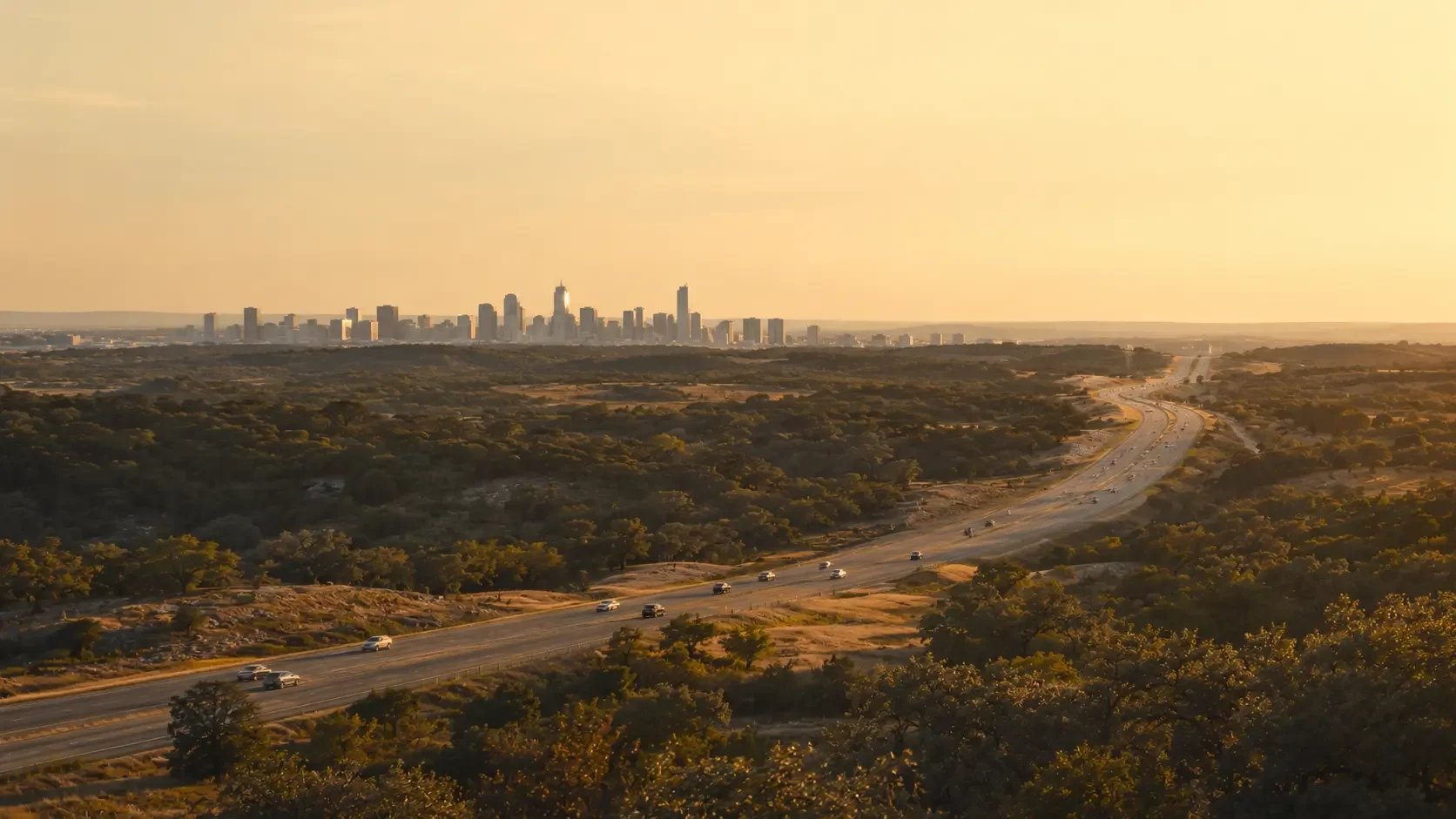
Highway 71 west of Austin is changing from a commute into a destination. Private golf, a wellness resort, a planned town, conservation land and a local aerospace employer are all arriving along the same road. Here is what is being built, where things stand in October 2026, and what it means if you own or are buying on the west side of Austin.
Update, October 2026. Since this issue ran, Aman has filled in its plan for Amansanu, a ranch resort and residences on 1,600 acres between Llano and Fredericksburg, at the far end of the Highway 71 drive. Canyon Ranch Austin set October 15 as the day it began welcoming guests. Read The Westsider No. 08 on Amansanu.
The corridor, east to west
For years the drive west on Highway 71 meant leaving the city behind. Today the road strings together established neighborhoods, private clubs and some of the largest new projects in Central Texas. The map below follows the drive from downtown to Spicewood.
- Downtown AustinWhere the drive starts. A $1.6 billion convention center rebuild is planned to reopen for events in 2029.Start
- Southwest ParkwayThe edge of the city gives way to the west side.Gateway
- Spanish OaksPrivate golf in Bee Cave, and the proof that buyers will drive west for privacy.Private club
- Bee CaveShopping, offices and CesiumAstro, a local aerospace and defense employer.Jobs + retail
- Serene HillsDiana’s home community, at the hinge between Bee Cave and Lakeway.Neighborhood
- Lakeway, up RM 620Baylor Scott & White Medical Center, schools and mature infrastructure.Established
- Reimers-PeacockPeacock Preserve: more than 1,400 acres and 80 planned homesites.Conservation
- SpicewoodThe western end, with four separate projects.Four projectsGolf + lakeTravis ClubGolf, Lake Travis shoreline and marina access.Wellness resortCanyon Ranch AustinMore than 600 acres. Open to guests since October 15, 2026.Private club communityLoralomaGated, members only, McLay Kidd golf and river frontage.Master-planned townThomas Ranch2,200 acres with a public downtown. First residents early 2027.
Thomas Ranch is an attempt to create a new center
Thomas Ranch is not another subdivision. It is planned across roughly 2,200 acres for about 3,500 residences, built over 12 to 15 years. The plan includes a public downtown with more than 250,000 square feet of restaurants, shops and services, plus education, specialized healthcare, cultural uses and a five-star boutique resort. Community Impact reported in May 2026 that the first residents are expected in early 2027.
That changes the economics of living farther west. Grocery stores, restaurants, doctors and jobs do not only follow housing. Once enough of them exist, they make more housing possible. Development creates demand for infrastructure, and infrastructure makes the next round of development possible.
Loraloma is a separate project
Loraloma sits next to Thomas Ranch and the two are often confused. They come from the same developer, Areté Collective, but they are different purchases. Loraloma is a gated, members-only club community built around David McLay Kidd’s first Texas course, which debuted in October 2025, with more than two miles of river frontage. Read the Loraloma guide
Peacock Preserve sells scarcity
Near the Reimers-Peacock corridor, Peacock Preserve is close to the opposite of a master plan: more than 1,400 acres, 80 planned homesites, about 90% of the land represented as permanently conserved and a planned 12-mile trail network.
It belongs in this story because it shows how many forms demand on the west side can take. Some buyers want a walkable town. Others want a club or a wellness resort. Peacock Preserve is selling distance from development.
Industry east of Austin, and what it means out west
Elon Musk is not a West Austin story. Tesla and SpaceX are concentrated east and southeast of the city. A state-supported SpaceX expansion in Bastrop includes more than $280 million in investment, roughly one million additional square feet and more than 400 jobs.
What matters for the west side is the wider effect. Aerospace, AI, semiconductors and advanced manufacturing across Central Texas bring suppliers, specialized companies and high-income households to the region. Bee Cave now has a local anchor of its own in CesiumAstro, an aerospace and defense company. Whether that grows into a larger cluster is one of the corridor’s most important questions.
Past Spicewood: Aman heads toward Llano
Highway 71 keeps going after Spicewood, all the way to Llano. Between Llano and Fredericksburg, Aman is planning Amansanu: 1,600 acres, a resort of 52 standalone pavilions and a small collection of Aman Residences on lots of at least 10 acres. No opening date or prices have been announced. It’s 90 minutes from Austin, so it won’t change values on the west side of Austin by itself, but it shows how far out the luxury economy is now willing to build. More in The Westsider No. 08.
Where things stand
Some of this is open today. Some is months away, and some is still a plan. When you are pricing a home or a homesite, the difference matters.
What could slow it down
Private money is moving faster than some of the public systems underneath it.
Water. West Travis County Public Utility Agency paused new commercial service-extension applications in 2026 while it works on supply and capacity.
Roads. Bee Cave planning identifies capacity challenges on SH 71 and Hamilton Pool Road, with new routes and intersection work studied or planned.
Workers. Resorts, hospitals, clubs and schools need nurses, teachers, tradespeople and first responders who can afford to live within reach.
What this means if you are buying or selling
Buying. Price what exists, not what is promised. Ask which amenities are open today, what the full carrying costs are and how many closed sales actually support the price. New communities often have very few. How Diana works with buyers
Selling on the west side. The new projects are part of your story too. Buyers comparing a resale home with a new community are weighing finished roads, services and short drives against amenities that are still being built. Price and present your home for that comparison. How Diana prepares a home for market
Keep reading
Next step: Ask what the corridor means for your home’s value.